
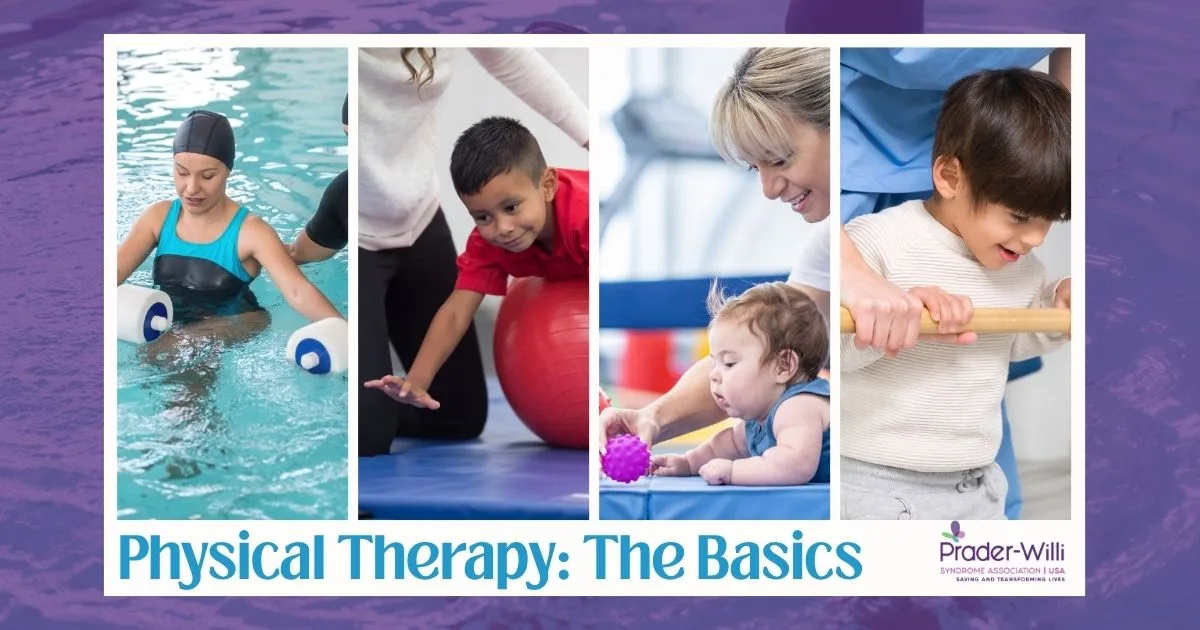
The information below is taken from our booklet, “Therapeutic Interventions for the Child with Prader Willi-Syndrome”, written by: Janice Agarwal, PT, CNDT, along with some edited quotes from an upcoming PWS United podcast episode with Janice Agarwal and Abbie Ogilbee, PT, DPT. Be sure to read the full details on specific strategies or activities in the booklet at Therapeutic-interventions-1-1.pdf Listen to the podcast episode at PWS United | PWSA | USA
Physical therapy is a common, and often critical therapy in the development of individuals with Prader-Willi syndrome. Due to hypotonia, individuals with PWS experience developmental delays in both gross motor, fine motor, and oral motor skills. Early intervention and therapies like physical, occupational, and speech can offer tremendous support to these individuals, helping them develop and sharpen necessary skills. October is Physical Therapy Month, so we’re taking this moment to remind our families of the importance of physical therapy, early intervention, sensory integration, and how to find ways to implement beneficial activities into everyday life.
What is physical therapy?
Physical therapy is an ongoing treatment of specific activities designed to help improve gross and fine motor skills, balance and coordination, strength and endurance, as well as enhancing learning opportunities and sensory processing/integration. Physical therapy can begin as early as infancy and continue throughout an individual’s life, depending on their need.
“The goal of physical therapy is to facilitate normal development of gross motor skills, not to artificially accelerate the rate of gross motor development. It’s important not to put too much emphasis on when our infants achieve their milestones, and to focus instead on how well our infants achieve each stage of development. These stages need to be achieved in the correct sequence, so that each subsequent stage can be built on the solid foundation of the prior stage. Although almost all our infants will eventually obtain motor skills (regardless of the speed or order in which they are acquired), developing motor skills in the proper order ultimately translates into better strength and coordination.”
As your loved one ages, their need for or compatibility with physical therapy will likely change. Whether or not your loved one continues with physical therapy into their adulthood, or comes in and out as needs arise, beginning physical therapy as young as possible is a key element for successful development. Early intervention should be a part of every PWS journey.
What is Early Intervention (EI)?
“Early Intervention is a systematic program of therapy, exercises, and activities designed to address developmental delays that may be experienced by children with PWS or other disabilities. These services are mandated by a federal law called the Individuals with Disabilities Education Act (IDEA). The law requires that states provide EI services for all children who qualify, with the goal of enhancing the development of infants and toddlers and helping families understand and meet the needs of their children. Early Intervention should begin any time shortly after birth and should usually continue until the child reaches age three.”
The development that occurs during the first few years of life builds the foundation for future progress. During this time, they are building the basic physical, cognitive, language, social, and self-help skills to carry with them throughout their life. This developmental time is critical, and it is important to support your loved one with appropriate tools, like physical therapy and early intervention. Having a professional physical therapist on your child’s care team at this time can help ensure that they are reaching their milestones in an appropriate, productive, and successful way. Physical therapists are trained to understand the development process and how to support individuals who need guidance.
“Development is a continuous process that begins at conception and proceeds stage by stage in an orderly sequence. There are specific milestones in each of the five areas of development (gross and fine motor abilities, language skills, cognitive development, social development, and self-help skills) that serve as prerequisites for the stages that follow. On their own timetable, infants with PWS will achieve each of the same milestones in the same order as other children. Remember, in monitoring the development of a child with Prader-Willi syndrome, it is more useful to look at the sequence of milestones achieved, rather than the age at which the milestones are reached.”
So maybe you don’t need to throw out that book on “the first few years of development,” but perhaps cross out the expected ages and let your loved one work through the development process at their own pace, with the help of a physical therapist that is. And remember that even in the PWS world, our loved ones are different. How rapidly or slowly one individual with PWS develops does not signify how another one might.
“But the first thing I always say is don’t bring that child upright until they’re ready because, when a child develops normally, they develop from their trunk to their extremities, but our children develop from their extremities to their trunk. Therefore, I don’t want to bring them upright to stand until their trunk is very, very stable.
You may have a child, sometimes that’s a year old, that’s still not really sitting well or moving to sitting well. They’re definitely not standing. But until they’re ready to do that and they have the trunk strength to do it, don’t encourage that.
And what I have found—I have followed kids for a long time—and those parents that kept their kids down longer, especially on their belly, the kids gained a couple of different things.
They gained all that visual acuity kids get. They see something and they learn to pick it up and they learn distances, but they also learn how to keep their arms stronger.” (Janice Agarwal, PWS United podcast episode)
Typical Challenges for Children with PWS
Though it is important to remember that all our loved ones are individuals in their PWS experience, there are some common challenges that most, if not all individuals with PWS experience. Because we can identify these challenges, we can also be well-equipped to navigate them. Make sure your loved one’s physical therapist is aware of these common challenges to best support them.
- *Hypotonicity (low muscular tone): Seen as excessive floppiness and inactivity. Movement is how children learn. If a child loses even a few months of this movement and exploration, their cognitive and physical development can be adversely affected.
- *Hip subluxation: May occur when the child’s thigh and pelvic muscles are hypotonic. Legs are abducted (like doing the splits) and externally rotated (pigeon-toed). An x-ray may be warranted.
- *Muscle Strength: The amount of force a muscle can produce with a single maximal effort.
- *Motor Planning: Brain-body communication that allows one’s brain to make a plan of action and have one’s body carry it out.
- *Dyspraxia: Difficulty in planning, sequencing, and carrying out unfamiliar actions in a skillful manner.
- *Gross Motor Skills: Movements that involve large muscle groups for crawling, walking, running, and other activities.
- *Fine motor skills: Movements of smaller muscles for actions such as grasping objects.
- *Scoliosis: Abnormal lateral (sideways) curve of the spine.
- *Sensory Awareness: Experiences that include touch, movement, body awareness, sight, sound, and the pull of gravity. The process of the brain organizing and interpreting this information is called Sensory Integration (SI) which provides a crucial foundation for later, more complex learning and behavior. (See part 2 for more about Sensory Integration)
Why is it important to start physical therapy early for individuals with PWS?
“Infants with Prader-Willi syndrome don’t move as much in utero as they should. Therefore, when they come out, obviously they’re not moving as well and as properly. So, the very soonest that you can get in and start replicating the things that they have missed, that hands to mouth, that learning their center of gravity, that learning to bring their bodies, that overall sensory awareness, the sensory feeling where their arms are in space. And then learning to get on the ground, prone and supine to make sure that they get all their muscles’ structures as strong as possible, it all starts day one because they’ve missed it in utero. You cannot give enough therapy sessions. You cannot do enough massages. You cannot do enough trying to introduce them to their body parts because they’ve missed a lot of that in utero.” (Janice Agarwal, PWS United podcast episode)
“We need to give our kids some more trunk support because that is one of the biggest weaknesses that I see in our kiddos or just any child with low, low tone. There are some really great options for trunk support for infants and toddlers that are still learning how to engage their core: TheraTog suits. There are some great supportive straps that go along with that to engage and have more body awareness for the abdominals or the spinal erectors that you can add those spinal supports and your therapist can help with that if they’re trained in the TheraTog suits. I personally really loved it. The other one is the Cryo suit, and it’s a newer suit that has come out probably just in the last year. It’s easier to put on and it has a bit of a zipper in the front and it goes around the legs, around the thighs. So, we get a bit more of that pelvic support along with the shoulder straps. We’re really engaging the core from the bottom and the top and then going around. I like those two suits. There’s also over the counter ones that you can just get off of Amazon, like the smart knit tank tops are great. Again, just giving that overall compression to the core. We don’t get that proprioceptive input when we have low muscle tone.” (Abbie Ogilbee, PWS United podcast episode)
Physical Therapy Throughout Life
While professionally guided physical therapy is critical for our infants and adolescence with PWS, older individuals may not have access to a physical therapist. “There’s a lot of tools in a chest that therapists have, new and old, but the key comes down to your therapist is only there for a limited time, and so families have to figure how they can integrate things on a daily basis, to follow through, and encourage that.” (Janice Agarwal, PWS United episode)
Families of individuals with PWS who are seeing a physical therapist should remember this advice, that what they do at home on a daily basis from the guidance of the physical therapist is more beneficial than one or two sessions a week. “But it’s all of those things at home on a daily basis, which makes the greatest impact.” (Abbie Ogilbee, PWS United podcast) And quite often, the activities and movements are fun.
Even if an individual with PWS ages out of physical therapy or loses access for some reason, knowing PWS means knowing the necessity of regular movement. Our loved ones may not see a therapist regularly, but it is critical that they regularly participate in activities to move their bodies in dynamic and varied ways. The foundations of movement and body awareness may begin in utero, but the need for exercise and movement continues throughout life.
Physical Therapy at Home: Tips from PWS Parents
There are many ways to help ensure your loved one moves their body, activating different muscle groups and developmental pathways. Below are some suggestions for informal physical therapy from parents in our community:
*Structured Activities like swimming, horseback riding, dance classes, Special Olympics sports
*Join a YMCA or find classes at local rec center
*Download dance or fitness apps for fun activities anywhere
*Kids Yoga (Cosmic Kids Yoga – YouTube) (Yoga for Kids – YouTube)
*YouTube PT for low muscle tone: Pediatric Physical Therapy with a Low Tone Baby/Child – YouTube
*Enroll in “my gym” Activities for Babies and Kids | Children’s Fitness Centers
*Baby and Toddler Play Classes | Gymboree Play & Music
*Pediatric Physical Therapy Exercises – YouTube
*Karate with Cameron: Weekly karate classes taught on Zoom by Cameron Graziano who has PWS and a Black Belt in Karate. Focus is on building strength, stamina, balance, flexibility. Learn basic commands in Korean. (link to see a class: Karate with Cameron 2025 Session #17 )
Share this!


 Perry A. Zirkel has written more than 1,500 publications on various aspects of school law, with an emphasis on legal issues in special education. He writes a regular column for NAESP’s Principal magazine and NASP’s Communiqué newsletter, and he did so previously for Phi Delta Kappan and Teaching Exceptional Children.
 Jennifer Bolander has been serving as a Special Education Specialist for PWSA (USA) since October of 2015. She is a graduate of John Carroll University and lives in Ohio with her husband Brad and daughters Kate (17), and Sophia (13) who was born with PWS.
 Dr. Amy McTighe is the PWS Program Manager and Inpatient Teacher at the Center for Prader-Willi Syndrome at the Children’s Institute of Pittsburgh. She graduated from Duquesne University receiving her Bachelor’s and Master’s degree in Education with a focus on elementary education, special education, and language arts.
 Evan has worked with the Prader-Willi Syndrome Association (USA) since 2007 primarily as a Crisis Intervention and Family Support Counselor. Evans works with parents and schools to foster strong collaborative relationships and appropriate educational environments for students with PWS.
 Staci Zimmerman works for Prader-Willi Syndrome Association of Colorado as an Individualized Education Program (IEP) consultant. Staci collaborates with the PWS multi-disciplinary clinic at the Children’s Hospital in Denver supporting families and school districts around the United States with their child’s Individual Educational Plan.
 Founded in 2001, SDLC is a non-profit legal services organization dedicated to protecting and advancing the legal rights of people with disabilities throughout the South. It partners with the Southern Poverty Law Center, Protection and Advocacy (P&A) programs, Legal Services Corporations (LSC) and disability organizations on major, systemic disability rights issues involving the Individuals with Disabilities Education Act (IDEA), Americans with Disabilities Act (ADA), and the federal Medicaid Act. Recently in November 2014, Jim retired.