
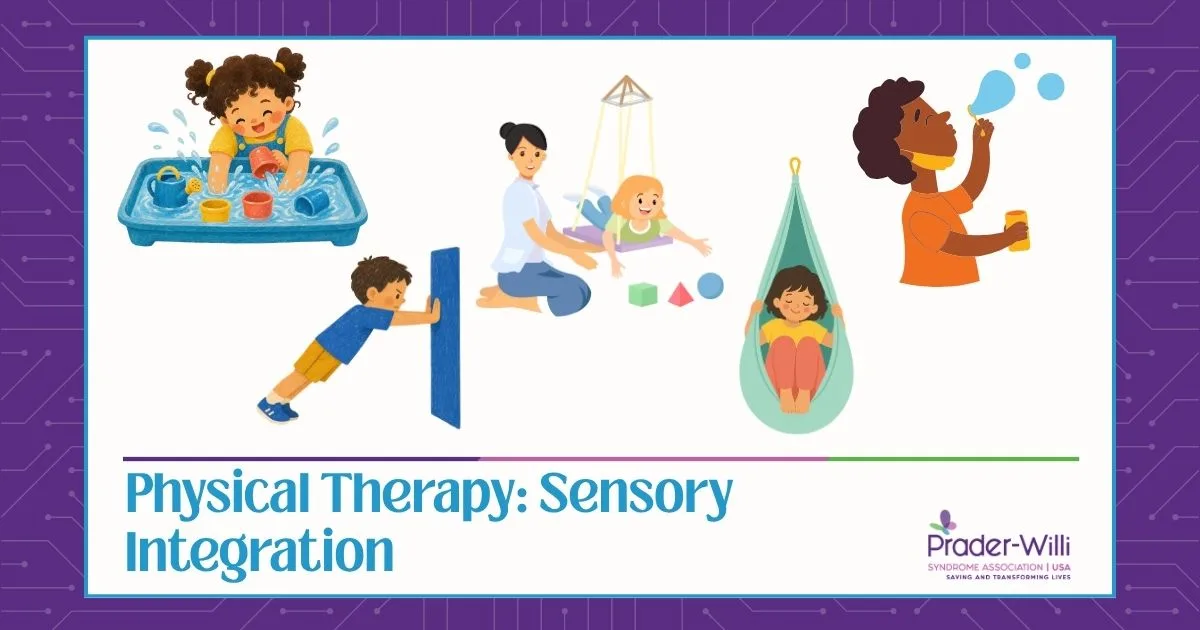
The information below is taken from our booklet, “Therapeutic Interventions for the Child with Prader Willi-Syndrome”, written by: Janice Agarwal, PT, CNDT, along with some edited quotes from an upcoming PWS United podcast episode with Janice Agarwal and Abbie Ogilbee, PT, DPT. Be sure to read the full details on specific strategies or activities in the booklet at Therapeutic-interventions-1-1.pdf Listen to the podcast episode at PWS United | PWSA | USA
We experience the world through our senses; taste, touch, sight, smell, sound. When infants have hypotonia (low muscle tone) like our loved ones with PWS, their interactions with the world are impeded, thus reducing necessary intake. This begins in utero with decreased fetal movement, carrying into the hypotonia diagnosis of infancy. From the beginning, our loved one’s sensory experiences are muted, causing developmental delays. Thankfully, we have an understanding of the need for these sensory experiences and ways to help support integration.
“Sensory integration is “the organization of sensory input for use.” This system enables the body to synthesize, organize, and process incoming sensory information received from the body and the environment to produce purposeful, goal-directed responses. Sensory dysfunction is the ineffective neurological processing of information received through the senses, causing problems with learning, development, coordination, and behavior.”
In a recent PWS United podcast episode, physical therapists Abbie Ogilbee and Janice Agarwal spoke about the need for comprehensive and daily therapeutic support for our loved ones. “What other things can I do to support my child in all areas of development? And that’s where we make the biggest impact on our children is that daily interaction with them. Like Janice was saying, all of those little fun activities, all of the different sensory experiences,” (Abbie Ogilbee, PWS United podcast)
“I will tell you how important that is…like we’d go to church or we’d go to event and Alex would be squirmy. Nobody likes to see a squirmy kid. And the first thing he would do is hand us his hand and we would do a deep massage and that would relax him and we could get through 15 minutes and then he’d give us his other hand or a foot or he’d sit in front of us and we would deep massage his head. What we’re doing is we’re releasing that serotonin, that very thing that allows kids to relax makes it so there is no adrenaline going. Serotonin cuts off adrenaline, so you don’t have to worry about the kid having a meltdown or having any issues. What you’re doing, you’re setting your child up to learn how to relax, how to be controlled, how to handle the inputs that are coming at them so they are not reacting in public or any place where they are where there would be a problem with someone. But also when he’s in school, you know, we would come up with those kind of ideas or sitting on balls or how can we make it so that he can be relaxed, get the most input, learn things while his body is being controlled? That starts day one with parents allowing those inputs so that as they get older, they need fewer of them, but they know exactly what they need. You can relay that to teachers and to therapists and to the other groups, making them successful for the rest of their lives. So what you start on day one, day 21, when they’re 21 years old, they still know how to regulate themselves.” (Janice Agarwal, PWS United podcast)
Sensory Integration
“Sensory integration theory is based on the understanding that neural plasticity (the ability to change) and sensory integration occur in a specific developmental order and that brain functions integrate the sensory and motor experiences. Four main sensory systems play a role in the growth and development of the child: vestibular, proprioceptive, tactile, and oral motor.”
Vestibular System
“Vestibular receptors are in the semicircular canals of the inner ear. Vestibular receptors provide information about movement, gravity, and changing of the head position, which helps us to stabilize our eyes when we are moving and tell us if objects around us are moving or remaining still. These skills affect balance, posture, righting reactions, muscle tone, seeing, attention, and regulation of behavior.”
This system is developed in utero and functional at birth, thus babies who experienced limited fetal movement (like our babies with PWS) will have vestibular dysfunction. Intervention should begin as soon as possible. This may simply look like rocking in a caregiver’s arms or in a mechanical rocking chair with head supports.
What we see when the vestibular system is weak:
- -Hypotonia
- -Difficulty learning new activities
- -Unpredictable behavior
- -Overly impulsive
- -Poor attention
- -No handedness (delayed emergence of dominance, right/left confusion)
- -Tends to take longer periods of time to accomplish age-appropriate tasks
What we do to strengthen the vestibular system:
Be sure to start at very slow, tolerable speeds. Babies may experience fear of the movement or position changes so assess for any signs of overstimulation. As your child grows to try new activities, be sure appropriate safety protocols and supervision are in place.
- -Swinging
- -Rocking
- -Bouncing
- -Games (ie hop scotch, ball catch, soccer, baseball, hockey, and tag. All of these will depend on the balance system, and learning them early will help to refine it.)
- -Scooter Boards
- -Trikes and Bikes
- -Rolling and sledding down hills
- -Rough housing and wrestling
- -Sliding down a slide
- -Somersaulting
- -Spinning
- -Walking, running, hiking, and swimming
- -Aerobic, dance, or Zumba classes
- -Wii-Fit and Xbox Kinect
- -Amusement park rides
Proprioceptive System
The proprioceptive system helps us understand where we and other objects or people are in the space we are in. Receptors in our muscles, joints, and connective tissue send information to our brains and spinal cords (our central and peripheral nervous systems), providing necessary information for body and spatial awareness, our balance, the force needed to contract our muscles for movement, and the relation of our body and body parts to each other and others, helping us navigate the space around us safely.
“By reassuring us that we are where we think we are, proprioceptive input can have a powerful calming and organizing effect.”
What we see when the proprioceptive system is weak:
- -Biting and chewing objects, fingers, or nails
- -Exerting too much or not enough pressure when handling objects
- -Grinding teeth
- -Mushy speech
- -Walking next to or gently touching walls
- -Seeking activities involving weights (Heavy work, jumping, crashing, pushing, and pulling)
- -Poor Writing
What we do to strengthen the proprioceptive system:
- -Gross motor activities
- -Brushing, rolling, deep massage
- -Digging in the garden
- -Carrying heavy items
- -Pushing or pulling heavy
- -Make a human burrito or
- -Tug of war with blankets or ropes
- -Catching and throwing weighted balls, beanbags, and cushions
- -Crawling through tunnels or boxes on the floor
- -Animal walks
- -Wheelbarrow walking
- -Walking, biking uphill, running obstacle courses
- -Hammering
- -Pounding and rolling Play Doh or clay
- -Hanging from monkey bars with supervision
- -Jumping on a trampoline, old mattress, or air mattress
- -Karate
- -Pillow fights or squishing between pillows
- -Pouring beans, sand, or water from one container to another
- -Swimming or extra bath time
- -Tumbling
Tactile System
As many surprised school kids eventually learn, the largest organ in the human body is not the brain or the lungs, but skin. We experience a lot of the world, such as textures and temperatures, through our skin via the tactile system.
“Stimulation of the tactile system is received by receptors in the skin, which is the largest organ of the body. The system has two components. The first is the protective system which senses if touch is harmful due to pressure, temperature and pain; the other is the discriminative system which senses the difference between harmful and beneficial touch.”
What we see when the tactile system is weak:
- -Desensitization to cuts and bruises, pain, and temperature
- -Does not like having hair or teeth
- -Flicks or shakes hands, rubs face
- -Licks or chews on lips
- -Picks at skin or hangnails
- -Sloppy handwriting, eating, and dressing
What we do to strengthen the tactile system:
- -Brushing, rolling, deep massage
- -Deep pressure and joint compression
- -Dress up boxes with gloves, shoes, hats etc
- -Massage hands
- -Painting, finger painting or with brushes
- -Pet care — brushing, grooming, petting
- -Scavenger hunts
- -Sensory buckets
- -Sitting on padded seats, beanbag chairs, or air cushions
- -Playing musical instruments, piano, bells, drums, rhythm sticks
- -Temperature variation
- -Warm beds
- -Weighted blankets
Oral-Motor System
As likely any parent of an individual with PWS will tell you, feeding struggles begin at birth. Of course, the struggles of an infant learning how to nurse are very different than the hunger drive of hyperphagia. But adults also may struggle with swallowing, breathing, and articulate speech. Working on the oral-motor system from the start can help our loved ones immensely throughout their lives.
“Eating is the most sensory-intensive activity. Oral-motor issues such as sucking and chewing difficulties are due to weak lip, cheek, and tongue muscles and lack of jaw stability. A child’s lack of early hand-to-mouth and toy-to-mouth play also contributes to increased sensory deficits.
Oral-motor input plays a large part in maintaining a child’s/individual’s level of sensory arousal:
- *Oral function is connected to posture and respiration.
- *Oral-motor control relies on proper stabilization of the head, neck, and trunk.
- *Suck-swallow-breath synchrony plays an important role in a child’s arousal levels.
- *Oral-motor input (sucking) induces a calming and self-regulating state to allow an infant to learn about sensory input.
- *Oral-motor input can help a child calm or alert themselves so that they can play and interact with their peers.
- *Eating is the most sensory intensive activity.”
Using a variety of tastes, textures, and temperatures in your loved one’s diet can help encourage necessary skills like sucking, blowing, biting, chewing, and licking. Work with a speech or occupational therapist to develop a diet plan that helps stimulate oral-motor activity.
The oral-motor system may seem like an isolated system compared with the rest of the body, but these systems are related. Properly and effectively supporting the oral-motor system can also support gross motor function.
- *Sucking can promote increased trunk flexion.
- *Blowing can promote trunk extension.
- *Biting can promote jaw, neck and shoulder, and pelvic stability.
- *Crunching and chewing can promote balance/stability and mobility in the jaw, neck, shoulder, and pelvis.
What we see when the oral-motor system is weak:
- -Difficulty sucking or blowing through a straw
- -Grinding teeth
- -Inappropriate use of tongue and lips
- -Poor suck and swallow.
- -Prefers to eat only sour, pungent, salty, or bland
What we do to strengthen the oral-motor system:
- -Blowing (bubbles, whistles)
- -Tugging, biting, pulling (fruit leather, beef jerky)
- -Offer variety of flavors: sour/tart like cranberries or lime wedges
- -Offer variety of food textures and temperatures: cold or warm, chewy, crunchy, warm
Share this!


 Perry A. Zirkel has written more than 1,500 publications on various aspects of school law, with an emphasis on legal issues in special education. He writes a regular column for NAESP’s Principal magazine and NASP’s Communiqué newsletter, and he did so previously for Phi Delta Kappan and Teaching Exceptional Children.
 Jennifer Bolander has been serving as a Special Education Specialist for PWSA (USA) since October of 2015. She is a graduate of John Carroll University and lives in Ohio with her husband Brad and daughters Kate (17), and Sophia (13) who was born with PWS.
 Dr. Amy McTighe is the PWS Program Manager and Inpatient Teacher at the Center for Prader-Willi Syndrome at the Children’s Institute of Pittsburgh. She graduated from Duquesne University receiving her Bachelor’s and Master’s degree in Education with a focus on elementary education, special education, and language arts.
 Evan has worked with the Prader-Willi Syndrome Association (USA) since 2007 primarily as a Crisis Intervention and Family Support Counselor. Evans works with parents and schools to foster strong collaborative relationships and appropriate educational environments for students with PWS.
 Staci Zimmerman works for Prader-Willi Syndrome Association of Colorado as an Individualized Education Program (IEP) consultant. Staci collaborates with the PWS multi-disciplinary clinic at the Children’s Hospital in Denver supporting families and school districts around the United States with their child’s Individual Educational Plan.
 Founded in 2001, SDLC is a non-profit legal services organization dedicated to protecting and advancing the legal rights of people with disabilities throughout the South. It partners with the Southern Poverty Law Center, Protection and Advocacy (P&A) programs, Legal Services Corporations (LSC) and disability organizations on major, systemic disability rights issues involving the Individuals with Disabilities Education Act (IDEA), Americans with Disabilities Act (ADA), and the federal Medicaid Act. Recently in November 2014, Jim retired.