
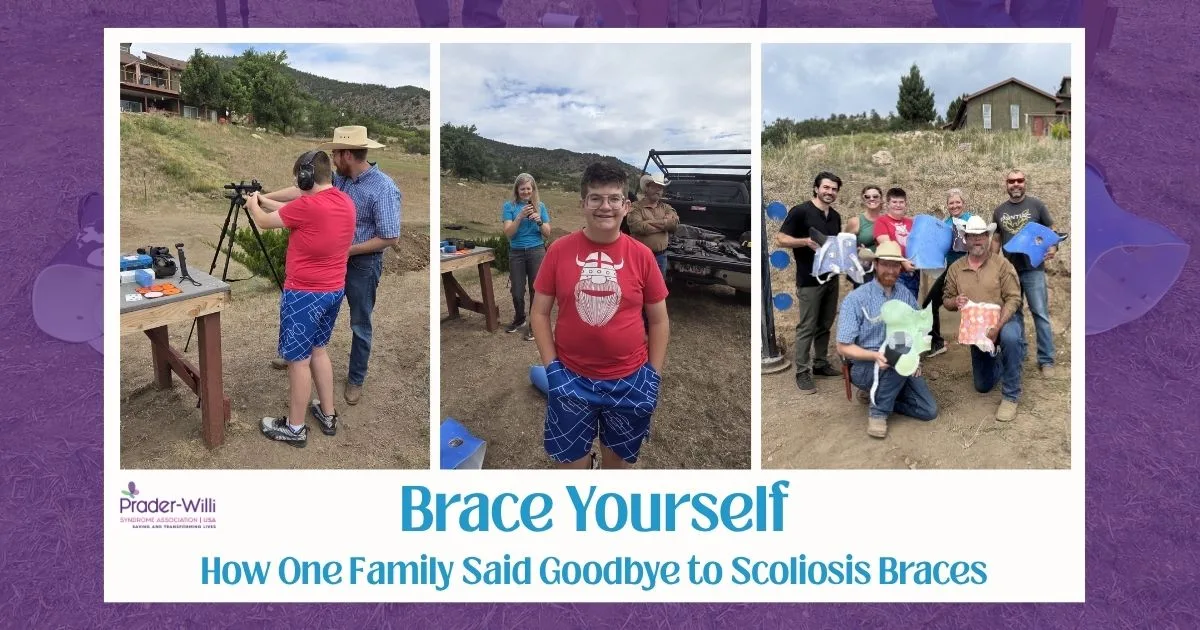
contributed by Kat Lucero, mom to Ronan (living with PWS) and PWSA | USA Board Member
I think the day I discovered that Ronan had scoliosis was one of the saddest and most eye-opening days of my journey as his mom.It was the moment I realized that I couldn’t protect him from everything Prader-Willi syndrome was going to throw our way. Ronan was still young. He had been seen by so many doctors and specialists, which made what happened next even harder for me to understand.
One evening, he came into my bedroom to show me something. As he walked away, wearing his little blue pajamas covered in police cars, I noticed a small crease in the middle of his back. Something didn’t look right. I called him back. There it was. His own mom had found something that somehow everyone else had missed.
An X-ray later confirmed that Ronan had scoliosis, with a 24-degree curve. At first, the recommendation was to watch it. So we watched. And watched.
Unfortunately, we watched that curve continue to grow. We tried everything we could. Ronan participated in hippotherapy and other therapies, and eventually bracing became a major part of his life. Over the years, Ronan would have eight scoliosis braces. Eight.
If he had to wear them, though, Ronan was determined to make them his own. He helped design his braces, and most reflected one of his greatest loves: police officers. There were police cars, blue camouflage, and one brace covered with police badges from around the United States. One design even made it look like he had a set of police handcuffs, keys and a police cruiser. He was very proud of that one!
By the time we got the 7th brace, I think he had simply run out of ideas. He chose blue with animals on it. I think he was just done. Done with braces. Done with scoliosis. Done with having one more thing in his life that he didn’t get to choose.
At one point, his orthotist asked him a question. “What are you going to do with all of these braces someday? Because one day, you won’t have to wear them anymore.”
Ronan thought about it. “I don’t know.”
Knowing how much he loved police officers—and knowing that target shooting was something that might appeal to him—she came up with an idea. What if, when the time came, we gathered everyone together and let Ronan use those old braces for target practice?
To Ronan, this sounded like possibly the greatest idea anyone had ever had.
But that day was still a long way off.
When Bracing Was No Longer Enough
Eventually, Ronan progressed to wearing a nighttime brace.
There is really no graceful way for me to describe that thing.
It looked like a torture device.
Getting him positioned inside it at night was an ordeal. If he needed to use the bathroom, I had to wake up with him, help him out, and then get him situated back inside of it again.
Meanwhile, his scoliosis continued progressing.
His curve reached the 50-degree range. At one point we were able to gain a small amount of correction, but it didn’t last. Eventually, his curve progressed to approximately 80 degrees at its worst point.
It began affecting his breathing.
After years of watching, treating, bracing and hoping, we knew it was time.
Ronan underwent scoliosis surgery.
And after everything he had been through, those eight braces were finally part of his past.
Time to Say Goodbye
A few months after surgery, Ronan finally got his wish.We gathered together for a day dedicated to saying goodbye to those braces once and for all. And Ronan got to use them for target practice. Oh. My. Gosh.He had the BEST time.
With experienced adults supervising and teaching him safe handling, and everyone using appropriate eye and hearing protection, Ronan learned how to shoot at the targets safely. And, apparently, my child is a natural.
He was hitting targets; his braces and having the time of his life. I think Ronan was slightly disappointed to discover that scoliosis braces are apparently much harder to destroy than he had imagined. But that certainly didn’t stop him from trying. He put a lot of determination into that nighttime brace in particular. I can’t imagine why.
Even more special was having people there who had been part of his scoliosis journey. His orthopedic doctor joined us, participated in the day and stayed for the entire event. Here was this doctor who had been there through such a difficult chapter of Ronan’s life, now standing with him on the other side of it. Not in an exam room. Not looking at an X-ray. Not talking about degrees of curvature, another brace or another treatment. Just celebrating him.
More Than Eight Braces.
Looking back, I realize those braces represented much more than scoliosis. They represented years of appointments. They represented uncomfortable days and difficult nights. They represented watching a curve grow despite everything we were doing to stop it. They represented something Ronan had to wear because his body required it not because he chose it. And they affected all of us; Armando, Julian and me. Scoliosis didn’t happen only to Ronan. In different ways, our entire family traveled that road with him. That is why this day meant so much more than simply shooting at some old braces. It was an ending.
For years, those braces had been something Ronan had very little control over. On this day, he finally got to decide what happened to them. He was ready to be done. Ready to stop thinking about them. Ready to move forward.
And watching my son standing there, happy, confident and completely enjoying himself after everything he had been through was something I will never forget. There was no fear. No brace. No appointment. Just Ronan with the biggest smile on his face.
And it was epic.
Share this!




 Perry A. Zirkel has written more than 1,500 publications on various aspects of school law, with an emphasis on legal issues in special education. He writes a regular column for NAESP’s Principal magazine and NASP’s Communiqué newsletter, and he did so previously for Phi Delta Kappan and Teaching Exceptional Children.
 Jennifer Bolander has been serving as a Special Education Specialist for PWSA (USA) since October of 2015. She is a graduate of John Carroll University and lives in Ohio with her husband Brad and daughters Kate (17), and Sophia (13) who was born with PWS.
 Dr. Amy McTighe is the PWS Program Manager and Inpatient Teacher at the Center for Prader-Willi Syndrome at the Children’s Institute of Pittsburgh. She graduated from Duquesne University receiving her Bachelor’s and Master’s degree in Education with a focus on elementary education, special education, and language arts.
 Evan has worked with the Prader-Willi Syndrome Association (USA) since 2007 primarily as a Crisis Intervention and Family Support Counselor. Evans works with parents and schools to foster strong collaborative relationships and appropriate educational environments for students with PWS.
 Staci Zimmerman works for Prader-Willi Syndrome Association of Colorado as an Individualized Education Program (IEP) consultant. Staci collaborates with the PWS multi-disciplinary clinic at the Children’s Hospital in Denver supporting families and school districts around the United States with their child’s Individual Educational Plan.
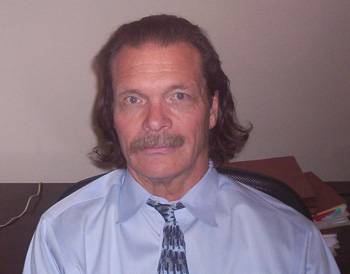 Founded in 2001, SDLC is a non-profit legal services organization dedicated to protecting and advancing the legal rights of people with disabilities throughout the South. It partners with the Southern Poverty Law Center, Protection and Advocacy (P&A) programs, Legal Services Corporations (LSC) and disability organizations on major, systemic disability rights issues involving the Individuals with Disabilities Education Act (IDEA), Americans with Disabilities Act (ADA), and the federal Medicaid Act. Recently in November 2014, Jim retired.