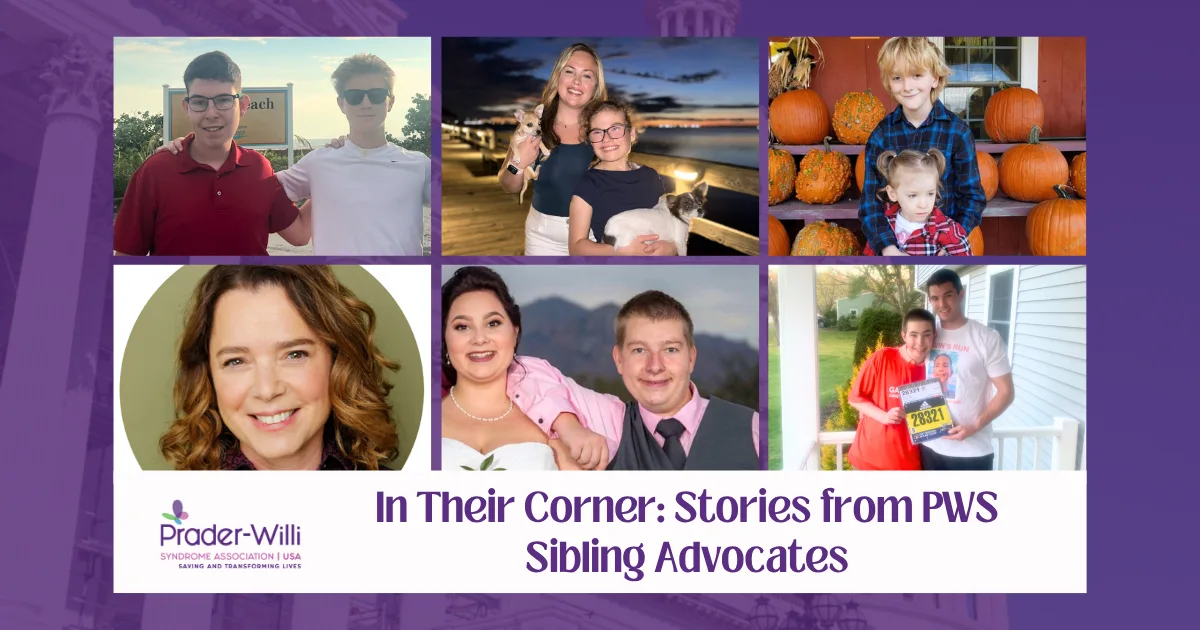
April 10th is National Sibling Day, and we’re honoring it by sharing stories from a few incredible sibling advocates in the PWS community. From taking their voices to Capitol Hill to organizing coffee shop and marathon fundraisers, these advocates open up about what sibling advocacy looks like in their lives and the advice they have for other PWS siblings. Scroll below to read their stories.
Rockie Penta: Caregiver, Roommate, Best Friend
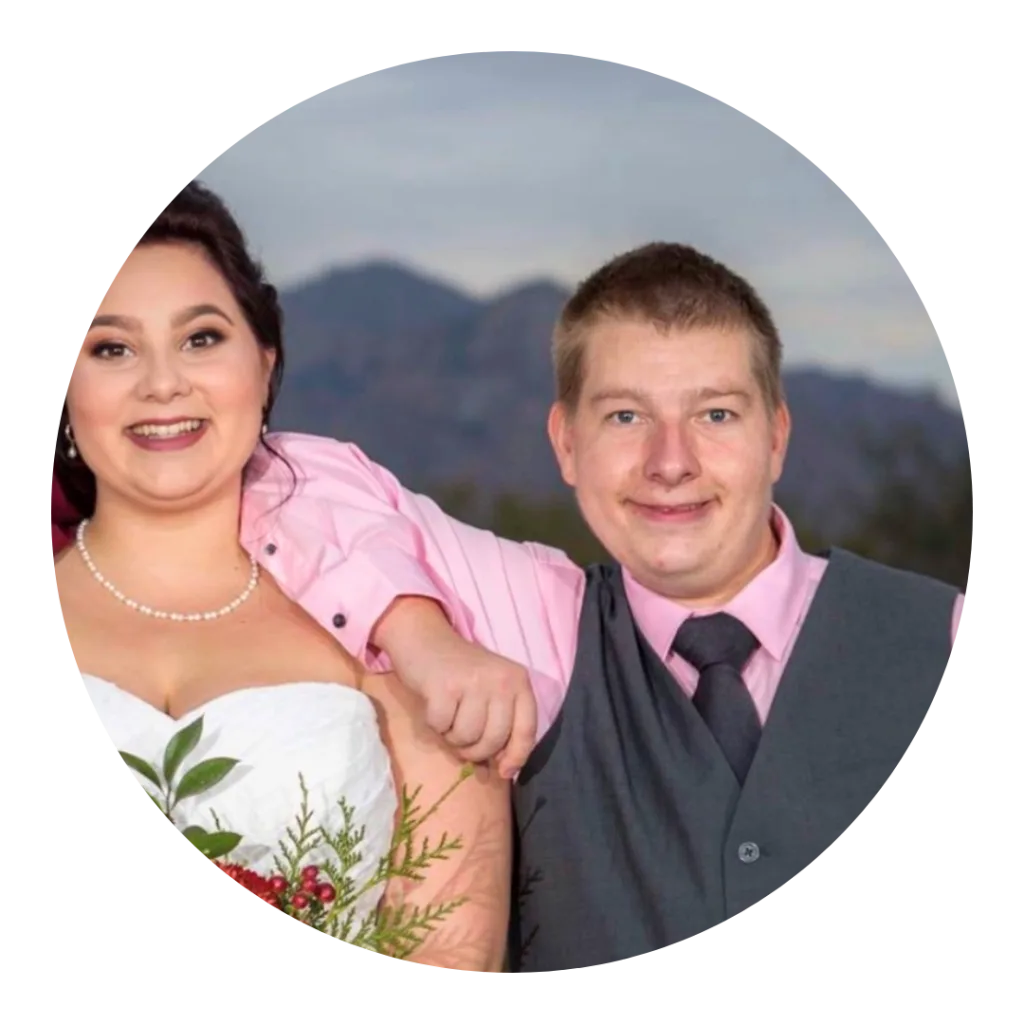
For Rockie Penta, advocating for her brother Victor isn’t just something she does, it’s simply part of who she is. The two have been roommates for over a decade, and Rockie describes Victor as her best friend.
“Victor has always had such a loving heart,” Rockie shares. “And watching him love my kids is the best thing that I think makes him unique. He’s very hands-on, very caring, and he knows that he couldn’t have kids, and that’s the one thing he wanted. He often tells me, ‘Thanks for giving me my two kids, but you can pay for them.’”
When it comes to advocacy, Rockie has learned to strike a careful balance between stepping back and stepping in. “I have always been the one that has stood back from Victor, and I try and let him advocate or speak up for himself,” she explains. “When I do step in, it’s when I notice the anxiety starting to set in or he’s starting to fumble on his words.”
That approach has paid off. Victor has served on PWSA | USA’s advocacy board for several years and has traveled to Washington, D.C. multiple times to represent the PWS community. “I am so proud of him,” Rockie says. “Not that I didn’t think he was capable of it, but I know him speaking has always been a very big challenge.”
Rockie also knows firsthand that sibling advocates need their own space to process the journey. Her vision for sibling advocacy? “A group that we could turn to when we just need to vent, because only us siblings understand the sibling experience.”
Henry McDonald: Dynamic Duo, Superhero

Henry McDonald and his sister Josie are, in his words, “a dynamic duo — like Batman and Robin.” But Henry’s advocacy has expanded far beyond their home. At just a young age, he attended a legislative meeting alongside families affected by other rare diseases, and it changed his perspective entirely.
“I realized for the first time that we were kind of all on the same team,” Henry reflects. “One out of every 10 Americans are living with a rare disease. So clearly, it becomes a much louder voice.”
Henry also navigates what many PWS siblings know well: taking on a secondary caregiver role. “I do feel like sometimes I’m put in that second parent kind of position,” he says. “I’m sometimes helping make decisions for Josie and what would be best for her. Obviously, I don’t have the same authority, but if my mom needs a second opinion or she just feels like, for whatever reason, she needs my help, I’m always there when I can be.”
His advice for finding balance? Communication. “Consistently communicating with the people who need you. Communicate to find a good way to balance your life and their life and this sibling’s life and your life together as a family.”
Joe Gill: Inclusion, Purpose, and the Little Things

Joe Gill describes his brother Gavin as someone with “the biggest heart” and “a very wild imagination” that keeps the whole family energetic and on their toes. Gavin, who is turning 20 this year, recently graduated from high school and is thriving in a post-secondary program.
For Joe, sibling advocacy has always been rooted in genuine support, and occasionally, a pair of running shoes.
In 2022, Joe ran the Boston Marathon to benefit PWSA | USA in Gavin’s honor, following in the footsteps of his father, who ran the same race when Gavin was just four years old.
What started as a fundraising page with a $8,000 goal quickly took on a life of its own. “Within four days we hit $16,000,” Joe recalls. “We ended up right around the $40,000 mark when it was all said and done in just about six weeks.” The experience taught him something powerful: “People want to help. They just want to know where and how.”
His advice to other PWS siblings is grounded in that same spirit of connection: “Be present with your sibling and spend time learning and building a relationship with them. Once you build that strong foundation, it’s that much easier to do everything else.”
Christian Garzia: Humor, Fairness, and Protection

Christian Garzia’s relationship with his brother Rocco is best summed up in two words: chaotic and funny. Funny because, as Christian shares, “During Christmas one year, we were picking up the Christmas presents under the tree, and my mom’s recording videos because we were little and she wanted to keep the memories. I’m over there in the corner picking up my gifts, and just when Rocco is trying to get up, there’s a prime time view of his butt crack. It was so funny that we go back
and visit that video, that picture every single year. We make fun of Rocco for it, but it’s not in a bad way because he’s always asked to be treated normally. And, we always make fun of my other brother Michael because he’s super hairy, and then we always make fun of me because I have a lot of hair on my head. I was always called ‘The Mop,’ Rocco was ‘The Crack,’ and Michael, I call ‘Bigfoot.'”
But when Christian joined PWSA | USA for an advocacy event, things got a little more serious, at least at first.
“I was super nervous. Whenever I was talking, I had to flex every single muscle I had just to stop shaking. But I was overall happy because I said, ‘Hey mom, let me do this. I bet I could do a good job.'”
And he did. So much so that his post-trip feelings did a complete 180. “Now I’m like, just bring me along next time. I don’t really care.” Christian’s story is a reminder that sometimes the most powerful step in advocacy is simply showing up and giving it a shot.
Miriam Chernick: Educating the Community

Miriam Chernick’s advocacy for her brother Daniel centers around one word: education. Specifically, educating caregivers, day programs, and the broader community about hyperphagia and food safety, because, as Miriam knows well, the gaps in understanding can have real consequences.
After months of persistent advocacy, she successfully changed the practices of Daniel’s day program, which had been regularly taking participants to fast food restaurants.
“It took me months to explain to them that this is like bringing an alcoholic to a liquor store,” she says. The change benefited not just Daniel, but others in the program as well. If Miriam had a magic wand, she’d use it to ensure that every day program and caregiving organization serving someone with PWS truly understands and complies with food safety needs. “We have found that to be the number one issue. They just don’t always get it.”
At the heart of it all, though, is her relationship with Daniel, one she describes with the word “trust.”
“I think I’ve learned to trust him more and not question everything he says, or to read between the lines, and he is very trusting of me,” Miriam reflects. “He really quotes me all the time as ‘Miriam said’ or ‘Miriam says.’ I think that comes from a place of love and caring.”
Kady Sweeney: See the Potential, Savor Typical Moments

Kady Sweeney was practically raised with an understanding of special needs. Her mother worked in special education before Kady’s sister Klara was born. But even with that background, Klara has become her greatest inspiration.
“If I could say one thing about her, it’s that she is an inspiration to me, to my family, to everyone she meets,” Kady says. At 15, Klara recently ran a half marathon, and Kady couldn’t be more proud.
Kady has channeled that pride into action from a young age. She learned to sew and sold handmade pillows (reading bones), bracelets, charms, and trinkets, donating 100% of proceeds to the Colorado PWS chapter. She’s given classroom presentations on PWS throughout her academic career. And alongside Rockie Penta, she co-founded the PWSA | USA Siblings Support Group where siblings can connect, vent, and celebrate together.
Her advice to other siblings is both practical and heartfelt: “Not every day is the same. Hold on to those moments of normalcy, reach out for support, and make it a point to join in on in-person gatherings. All of us get frustrated. All of us have to laugh sometimes. But at the end of the day, it’s your sibling and you love them always, no matter what.”
To all the PWS siblings out there: Thank you for showing up, speaking up, and standing alongside your loved one living with PWS. Happy National Sibling Day.
Share this!


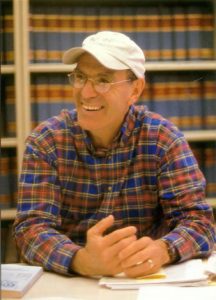 Perry A. Zirkel has written more than 1,500 publications on various aspects of school law, with an emphasis on legal issues in special education. He writes a regular column for NAESP’s Principal magazine and NASP’s Communiqué newsletter, and he did so previously for Phi Delta Kappan and Teaching Exceptional Children.
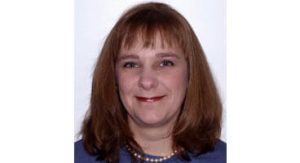 Jennifer Bolander has been serving as a Special Education Specialist for PWSA (USA) since October of 2015. She is a graduate of John Carroll University and lives in Ohio with her husband Brad and daughters Kate (17), and Sophia (13) who was born with PWS.
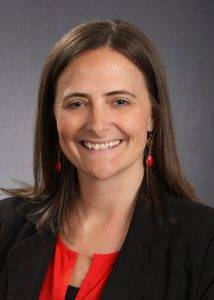 Dr. Amy McTighe is the PWS Program Manager and Inpatient Teacher at the Center for Prader-Willi Syndrome at the Children’s Institute of Pittsburgh. She graduated from Duquesne University receiving her Bachelor’s and Master’s degree in Education with a focus on elementary education, special education, and language arts.
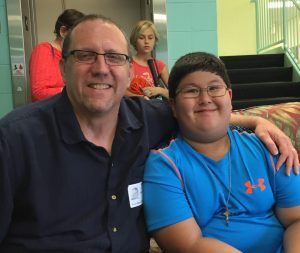 Evan has worked with the Prader-Willi Syndrome Association (USA) since 2007 primarily as a Crisis Intervention and Family Support Counselor. Evans works with parents and schools to foster strong collaborative relationships and appropriate educational environments for students with PWS.
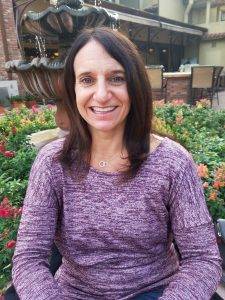 Staci Zimmerman works for Prader-Willi Syndrome Association of Colorado as an Individualized Education Program (IEP) consultant. Staci collaborates with the PWS multi-disciplinary clinic at the Children’s Hospital in Denver supporting families and school districts around the United States with their child’s Individual Educational Plan.
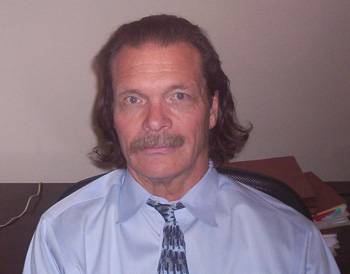 Founded in 2001, SDLC is a non-profit legal services organization dedicated to protecting and advancing the legal rights of people with disabilities throughout the South. It partners with the Southern Poverty Law Center, Protection and Advocacy (P&A) programs, Legal Services Corporations (LSC) and disability organizations on major, systemic disability rights issues involving the Individuals with Disabilities Education Act (IDEA), Americans with Disabilities Act (ADA), and the federal Medicaid Act. Recently in November 2014, Jim retired.